
Harrogate heritage: historian’s sentimental journey remembering market
For almost twenty years from 1995, the eminent local historian Malcolm Neesam contributed a series of remarkable articles to the Advertiser. In association with Harrogate Civic Society, we are proud to publish a selection from the series:
I hope, readers, that you will indulge me this week as I go on a sentimental journey through the Harrogate Market of my childhood.
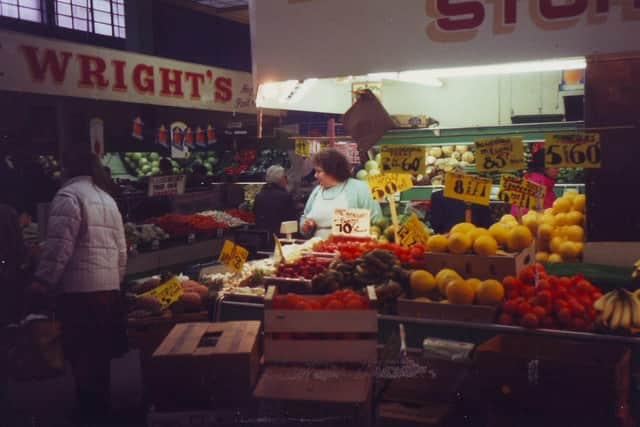

My excuse for such self-indulgence is that I recently acquired copies of a set of photographs of Harrogate’s Market building, taken in 1990, shortly before the building's most regrettable demolition.
The photographer was my good friend George Holmes, whom many readers may recall as the manager of the Yorkshire Bank back in the days when every customer knew and respected their bank manager.
What makes Mr Holme’s photographs so valuable historically, is that they show the appearance of the interior of the market on a busy shopping day, complete with stalls, staff, produce and customers. Back in the 1950s and 1960s, when I was growing up in Harrogate, the market was central to every shopping trip done by my mother, in that her usual shopping expeditions consisted of a visit to the market, and then to “other” shops.
The old market building was the second such structure to have stood on the site, the first of which had been built in 1874. When the Improvement Act of 1841 had been passed, it included clause 136, which empowered the Improvement Commissioners who ran the town to provide a market, an issue promoted enthusiastically by the Harrogate Advertiser since its edition of May 1, 1847.
Inevitably, public opposition to any kind of local expenditure ensured that the Commissioners were unable to act on their clause, even after the arrival of the railway in 1848. By the time the central station had been opened 150 fifty years ago this month, Harrogate was still without a market building.
Although the town had a growing number of permanent shops in High Harrogate, in Low Harrogate around the Royal Pump Room and Cold Bath Road, and in the expanding area of central Harrogate on the new thoroughfares of Beulah, Cambridge and James Streets, the town still lacked a central market building.
It was then that the land-owning Carter brothers sold the town 4.500 square yards of open land at the end of Cambridge Street. At five shillings a square yard, this was a bargain, but the public spirited Carter brothers inserted a clause in the conveyance that stipulated that the land was only to be used for a market, and - more interestingly - that if the land ceased to be used as a market, the authority should offer it back to the Carter family at the price it had been sold for.
Harrogate’s new market opened on August 29, 1874, and three years later, it received a splendid clock tower to house the clock given by Baroness Burdett-Coutts.
Until its destruction by fire on January 31 1937, the 1874 Market Hall served the town well. After the fire, the council decided to build a new Market Hall, which unlike the old one, would have two storeys, work on which had begun before the outbreak of World War Two in 1939.
Designed by Borough Engineer Leonard Clarke in a restrained neo-classical style, the new Market Hall (which never had a formal opening) was provided with a basement, something the original had lacked, which was used by the council as office space during the emergency years from 1939 to 1945.
By the early 1950s, when I first knew it, the basement was filled with retailers. In those days, my parents would have considered it an extravagance to have taken the car into town to do the shopping, so we used our feet.
The shopping bag was an essential item in every household, and my mother had several. On big shopping expeditions, she would carry four, each inside the other, and when one was filled, it was passed to me to carry, leaving the others free for further purchases.
Needless to add, father never came shopping, unless a special item was involved, such as the Christmas turkey, or a washing machine. We usually entered the Market Hall from the Station Square entrance, which was level, with two sets of doors. The Market Square entrance was also level, unlike that on Cambridge Street, opposite the St James Cinema, which had a steep flight of steps.
On entering the Station Square entrance, the stalls were arranged around the inner walls of the building, with a central aisle dividing them from north to south.
Halfway along the east and west side of the central stalls were two flights of steps that ran down to the basement, where a similar lay-out existed. If memory is correct, the stalls retailing baked goods, vegetables, meat, fish and poultry were all on the ground floor, with more hardware goods in the basement.
One thing I must point out to younger readers was that in the 1950s and 1960s, customers could not pick their own produce, but had to accept whatever the stall-holder selected for them in a paper bag. For this reason, my mother always avoided one vegetable stall, as she claimed they were in the habit of putting a bad potato in, and didn’t like the cheeky remarks of the assistant.
Where was I? Oh yes – at the Station Square entrance.
On the left, Mr. Hill’s greengrocery, which mother thought pricey but good. It was one of the few stalls that in summer sold my favourite fruit - Yorkshire bilberries, which I never see now, but which were far superior to the huge tasteless blueberries imported from America which are currently so fashionable. Hills also sold white currents, which my mother mixed with red currents and cherries to make a delicious pie.
Next stall was Moody the confectioner, which we visited after all the market shopping had been done and where, after sweet rationing had ended, I could buy sherbet dips from my thruppence a week pocket money. Then came Haywood the butcher, Hayes the fish-monger, Sutherland the poulterer, two more fishmongers, White and Carr, Winston's Biscuits and the Copper Kettle cafe. Smethhurst’s toys, on the Market Square side was a favourite of mine, especially near birthdays.
Just by the Market Square entrance was a newsagents that sold a seemingly vast selection of newspapers to satisfy every taste. More interestingly, to the eyes of a small boy, were the luridly illustrated covers of the magazines with such titles as Adventure in Space, Tales of Darkness, or the grotesque publications of the American horror genre.
These titles were in addition to the regular comics such as Eagle, Lion, and Beano, upon which I feasted each week.
It was just across the floor from the newsagents that Chapman and Quin later opened their wonderful delicatessen. There were always lots of customers around the big stalls, such as Marston and Wright, the fruiterers and greengrocers, Yorkshire Farmers (happily, still with us in Beulah Street), and Terry Howard the Baker.
Downstairs was even more interesting to me as a small boy. There was a double-fronted toy shop, possibly another of Smethurst’s stalls, Bornett, who sold pens and pen nibs, ink and stationery (which I often frequented during my years of secondary education), a hardware shop that sold lino from huge rolls on rack-mounted spindles, and a fire-place retailer who appeared to have an inexhaustible supply of tiled art-deco fireplaces.
Hamilton the watch repairer was a useful name to know, especially after l acquired my first watch at the age of 13.
A note from Harrogate Civic Society: It is now more than three years since Malcolm’s death. He left behind an astonishing body of work that we at the Harrogate Civic Society are determined should be preserved and enhanced for the benefit of future historians and, indeed, for the benefit of anyone who cares about Harrogate.
Not long before his passing, we discussed with Malcolm and the Advertiser republishing at least some of his articles.
Many of Malcolm’s articles dealt with the history of the town, exploring the people, places and events that helped to form the Harrogate we know today. At other times Malcolm concentrated more on contemporary issues.
While acknowledging that Harrogate could not stand still, he was convinced that change should always be tested. We are grateful to Malcolm’s family for their approval, to Simon Kent (closely involved with securing Malcolm’s legacy) for his work researching and preparing the articles for reprint, for the advice of historian Paul Jennings and to Graham Chalmers and his team at the Advertiser for their support and encouragement.
We hope you will enjoy reading (or in some cases re-reading) these irreplaceable snapshots of history.
If you are able to add to our knowledge, or wish to know more about our work, contact us at: [email protected].