
Former Harrogate RUFC supremo David Doherty swaps rugby balls for golf clubs in dramatic career change
For years he was a tormenter, his dazzling footwork and speed leaving opposing defenders grasping at thin air as he tore down the wing scoring tries for Yorkshire Carnegie, Wasps, Sale Sharks, England Sevens – and Harrogate RUFC.
Now he is the teacher, using his brain and his hands to mould the next generation of golfers.
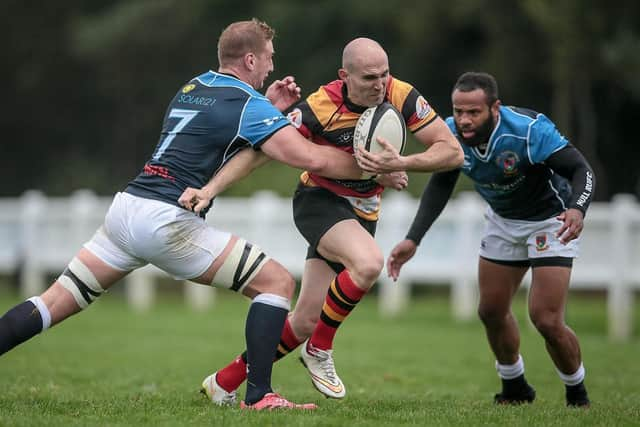

David Doherty’s transition from a career in rugby union to becoming a golf professional has been rapid – less than four years – and has taken even himself by surprise.
This is, after all, someone who only used to pick up a golf club in the summer when playing in a charity event arranged by whichever rugby club he was representing at the time, and even then, there was invariably a can of beer in the other hand.
He got his first handicap seven years ago, and that was an entry level 28.7.
“I was buzzing,” he recalls of the validation in September 2019, by which time he was working as the Harrogate Aces’ director of rugby.
“I remember how proud I was telling my wife when I broke 100 for the first time. I was still at the stage then where I’d go on golf days and I’d lose 12 balls in the first three holes. I was terrible.”
But now Doherty is a teaching professional at Wetherby Golf Club, his life completely transformed.
And it was through his first love of rugby that he started taking golf more seriously.
By the Covid summer of 2020, he had got his handicap down to 16 through what he describes as “sheer work ethic. I was no better at golf, technically. Just really trying hard and mitigating risk by taking irons.”
But it was still just a pastime, the fact Rudding Park Golf Club’s driving range was across the road from where he worked in Harrogate, a convenient place to spend his lunch hour.
But at the same time he was doing his level four coaching badges with the Rugby Football Union (RFU).
“I’d not had too many lessons by that point, I was pretty much self-taught,” says Doherty.
“But I was getting worse and also getting frustrated. So I had a couple of lessons at Grooves Golf at Rudding Park and that gave me a better framework. And I also had just done my level four postgraduate exams in coaching rugby.
“So I tried to use my coaching background with some technical knowledge I was picking up in golf to coach myself.
“Once I was in some slightly better technical positions and transitioning from rugby to golf with mobility, it just made it a lot easier.
“And I found it a lot more peaceful.
“The RFU actually inspired it. It was just a lucky coincidence that my dissertation for the RFU was on removal of self-doubt. I was looking at players that would miss key kicks or drop a high ball as a full-back.
“These really good players when under pressure would do silly things. And that lends itself to golf, and it especially lends itself to hand-eye coordination sports.
“The lead guy for the RFU suggested I take a year in a different sport to give me some grounding.
“He was basically saying, you need to be a little bit more rounded and see a different environment. So he suggested tennis or table tennis. But because I was playing golf, I decided to dedicate myself to that.”
At this point it should be made clear that Doherty is a natural sportsman. His playing career was in union but it could quite easily have been in two other sports.
He was a junior footballer good enough for Manchester United’s academy: “A few years after the Class of ’92,” he laughs, “but we ate in the canteen with some of those guys.”
When Manchester United didn’t offer him an education to run concurrent with his footballing development, he was counselled by his father to follow his older brothers into rugby league, and so joined his hometown Leeds Rhinos.
The move to Carnegie – then Leeds Tykes – to start his union career was a simple switch across the training paddock at Kirkstall. So he is clearly someone with sporting gifts and good hand-eye-coordination, but even then, he had so much to learn about golf.
“Even when I started coaching scratch players I was doing it with extremely little to no technical knowledge of golf,” he says of his early days at Wetherby.
“I would extract the information from them with questioning and get them to control their attention under pressure, and it works. There's coaches that have been working on people’s swings for 40 years. But I’m a pretty good problem solver. And when I'm under pressure, I feel like I perform reasonably well.
“So I was bringing that to the party, which is sometimes the final piece in the jigsaw.
“They could swing it like there's no tomorrow. But then under pressure, they're thinking about, gosh, what happens if I win or, you know, I need to conserve and make this. And all that's outside of that process.
"But in turn, people would help me with my game. So really good golfers, plus-two golfers, I was learning from them all the time.”
As someone for whom playing sport had previously come easy, was it a challenge for Doherty to transition into a mindset of having to work hard at something?
“Oh yeah, it was brutal,” he says.
“Golf didn't come easy to me. And it’s not just the practical side. I failed my first rules exam for golf because I've got no domain experience. I read the book, The Rules of Golf, twice, but I had no practical experience to fall back on to support that.”
And that informs how he teaches now.
“It's something that influences the way I coach people,” he says. “Golf is a challenging sport. It's very technical. I'll always say in the first lesson, we'll go on the course and see what you do.”
Doherty has come a long way in a short space of time, but at 39, might have two more decades to give to golf.
He says that he “loves” coaching, spending some 40 hours a week teaching at Wetherby. And given a sporting mentality borne out of all those days on the Man United, Rhinos and Carnegie training pitches, it comes as no surprise to discover his ambition.
“I want to be a world-class coach, that's the objective,” he insisted.