
'I thank my lucky stars': New bench unveiled in Harrogate as ‘living tribute’ to powerlifter who survived heart attack
An iconic red bench has been unveiled in Harrogate to recognise a local powerlifter who suffered a heart attack just hours after delivering a strength and conditioning coaching session.
Dean Dyble, 54, who represented England at powerlifting had been experiencing chest pains and what he believed to be indigestion for four days leading up to his heart attack at home in November 2024.
Dean’s red bench is one of 65 unveiled nationwide by the British Heart Foundation (BHF) to mark 65 years since the charity began and its decades of funding research into cardiovascular disease.
Dean’s bench has been placed in the grounds of the Old Swan Hotel, where he and his wife Leanne held their wedding reception in July 2011.
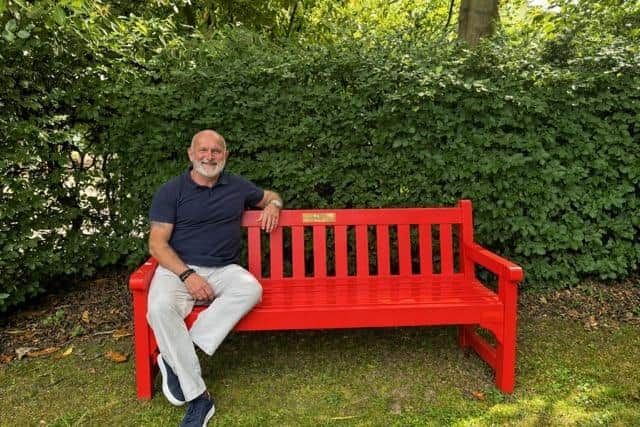

Dean said: “The hotel is a special place for us and it’s wonderful to be able to go back there now and sit there either alone or with Leanne and thank my lucky stars.
"I focus now on all the simple pleasures of life.”
A professional strength and conditioning coach, Dean had just completed a one-to-one session with a client at his local gym when he became so unwell that he decided to cancel his later clients and return to the home he shares with his wife Leanne and two sons.
Dean said: “Nobody was in, so I decided to call NHS 111 to ask for advice on what else I could take to ease the pain.
"I’m so very glad I did because the call handler recognised what was happening immediately.
"He asked me to reassure him I was sitting down and to make sure the front door was unlocked, explaining he was sending an ambulance immediately as he suspected I was having a heart attack.”
Dean was taken to Leeds General Infirmary where he underwent an emergency procedure to insert a stent into the coronary artery that caused the heart attack.
Dean said: “Before they did it they warned me that my heart might stop in 45 minutes and yet almost immediately after it I felt so much better.
"The pain in my chest had eased and I was up and about on the ward 40 minutes later and recovered relatively quickly.
“My parents had both suffered heart attacks, but I was so fit and strong and had a healthy lifestyle that I didn’t ever think I would be at risk.
"I wish I had taken more notice of the family history before now and got myself checked sooner, but at least I am here and I feel very lucky for that.
“I think it’s a great idea to celebrate the fact that people like me have been saved through the research that has been carried out by the British Heart Foundation.
“I have had my lows since the heart attack even though I know how lucky I am.”
Behind every bench is a powerful real-life story of someone living with a cardiovascular condition – and thanks to research, they can survive to enjoy life with their loved ones.
Every three minutes, someone in the UK dies from cardiovascular disease, with the condition affecting more than eight million people in the UK alone.
However, a new survey commissioned by British Heart Foundation of 2,000 UK adults living with cardiovascular disease has found that they can face judgement and embarrassment.
Dean said: “I certainly had challenges with my mental health and sadly I do feel I was judged by some people. Initially I felt euphoric that I’d survived, but then I started to struggle.
"I’d always thought I was doing everything right with my health and yet I came so close to death – that made me question the point of everything.
“After the diagnosis I was told I couldn’t lift anything heavy anymore and it was hard for me to come to terms with the fact that I couldn’t perform at the same level anymore because powerlifting was such a big part of who I am.
"I went to counselling for a while to work it all out and I read a lot of other people’s stories on the British Heart Foundation website about how they had adapted and come through.
“I’ve taken up a new sport, Brazilian Jujitsu, which is incredibly technical, cognitively demanding and still a good workout, but doesn’t put as much strain on my heart.
"The camaraderie I found there has been a Godsend too.
“The most hurtful thing for me when I went back to my coaching work was that I lost quite a few clients.
"I think they thought that I was finished as a coach and I do wonder if there was an element of them believing I had no credibility to coach now because of what had happened to me.
“Some of them dropped me like a stone – some didn’t even tell me.
"I’d worked with them for years and they just stopped using me – that hit my confidence.
"They thought I could no longer perform athletically and their perception of me changed.
“I’ve faced judgement from the medical profession too.
"I have to take Testosterone Replacement Therapy, which is prescribed to me because I was found to have low testosterone.
"One doctor I saw after my heart attack was critical of me for taking TRT and having a high protein diet.
"It felt like I was being blamed for bringing on the heart attack.
"It’s unfair and you really don’t need that because you feel guilty enough for having put your family through that frightening time.”
British Heart Foundation hopes that the red benches will encourage others to open up about their experience of living with cardiovascular disease, and help raise awareness across the UK.
The charity is also urging people for donations so they can help fund more ground-breaking research to keep the nation beating.
In 1961, most heart attacks were fatal - more than seven in ten people in the UK didn’t survive one.
We didn’t know what caused them, and there were no effective ways to prevent or treat them.
Today, with the help of decades of British Heart Foundation-funded research, those odds have been transformed by lifesaving treatments and better detection and prevention strategies.
Dr Charmaine Griffiths, Chief Executive at British Heart Foundation, said: “Dean’s story shows the true reality of living with cardiovascular disease, and we are so grateful that they are courageously sharing their experiences to help others.
“Despite being one of the UK’s biggest killers, our new findings show cardiovascular disease is still misunderstood or not taken seriously – and that those living with it face judgement and challenges.
“By sharing the stories of people who live with cardiovascular disease on our iconic red benches across the UK, we hope to start more conversations that change dangerous misconceptions.
"Research will help us save and improve more lives, but the only way we can fund the scientific breakthroughs of tomorrow is thanks to the public’s generous donations.”
For more information about British Heart Foundation, visit https://www.bhf.org.uk/