
OPINION: 'Down the Rabbit hole' - exploring Ripon's connection with Lewis Carroll
It was a thumping rain that sent me sprinting into Ripon Cathedral.
To fall into such deep wonder was down to a curious holey-ness.
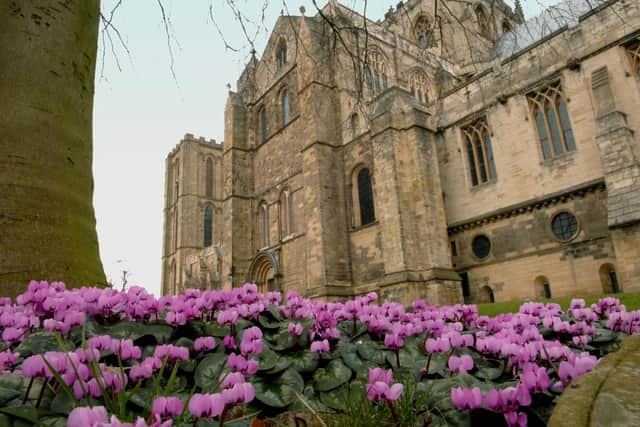

All down, in fact, to a humble revelation tucked in a book at the giftshop, that several architectural features in Ripon Cathedral are said to have inspired the fantastical Alice in Wonderland.
The story that transformed the landscape of children’s literature from moral terrain to magic, enchanting the young at heart.
By design, a portal to Wonderland will lead you from gawking to giddy and round again.
I found myself glued to the wooden choir stalls tracing my fingers over a carving of a gryphon chasing a rabbit down a rabbit hole, half expecting to tumble in after them.
Like Alice, my thoughts far from any practical concern of how in the world I might get back out again and fixed instead on something far curiouser.
In a city renowned for its horn blowing, where is the literary fanfare?
Left to a humble herald, Ripon’s claim to the world-famous dreamscape can escape the notice of locals and visitors.
Charles Lutwidge Dodgson, better known by his pen name, Lewis Carroll, spent time in the city as a young man while his father served as Canon-in-Residence at the Cathedral.
According to local historian, Maurice Taylor, the whimsical carvings beneath the choir seats, along with the twisting passageways of the Anglo-Saxon crypt, helped fire the young Dodgson’s imagination and planted the seeds for Wonderland.
Yet unlike the city of Oxford, Ripon has never gone to town on its literary connection.
The timing is particularly fitting, with the anniversary of Lewis Carroll’s birth on January 27.
“The Griffin, rabbit, turtle and blemya’s (creatures with faces in their torso - Mr Nobody and Mr Somebody) would all be familiar to Carroll,’’ Taylor noted in Lewis Carroll’s Ripon (1998) “as would the passage leading to the underground chamber of the crypt.’’
Taylor’s research was formally ‘hattified’ in August 2000, when 400 self-proclaimed Mad Hatters (members of the international Lewis Carroll Society) descended on the city for their annual conference.
The harebrained huddle sparked press coverage and the promise of Wonderland-style events.
But merriment has proved sporadic: sculptural tributes in the historic Spa Gardens (2013), a Mad Hatters Tea Party (2023), a couple of Alice-themed days at the Workhouse Museum (2024) and a city-wide White Rabbit Hunt (Summer, 2025).
Elsewhere in the UK, literary tourism is booming.

Cities from Bradford to Bath thrive on authorial heritage, drawing legions of year-round visitors.
A recent Publishing and Soft Power Report by the Publishers Association forecasts that the UK literary tourism market will grow from £1.7bn in 2024 to £2.1bn by 2030.
Canon Michael of Ripon Cathedral has been struck by the public fascination with Carroll: “I am personally asked more questions about Lewis Carroll, when passing through (the cathedral) than about the crypt, which is even older!”
The obstacle is perhaps a practical one.
With the Cathedral clergy focused on literal pilgrims and Dodgson’s former family home, Ripon Hall, privately owned, there’s little room for a Hatter to hang their hat.
And yet Taylor’s Lewis Carroll’s Ripon is brimming with narrative hooks.
It was at Mr Booth’s studio on North Street that Carroll’s fascination with the new art of photography took hold.
In 1864, he saw a photograph of the young Mary Hilton Badcock there and sent a copy of it to the artist Sir John Tenneil, suggesting her as the model for Alce.
At the Deanery (now the Dean Court Hotel) Carroll famously had his handwriting analysed by a leading graphologist, who declared its owner to possess ‘a very clever head … a great deal of imitation… wit and humour.’
Carroll would go on to pen parts of Through the Looking Glass in the city.
In Spring 1858 Carroll lodged at the Unicorn Coach House (now the Unicorn pub) in Market Place, where after the bustle and spectacle of market day, travellers, then as now, gathered to share tales of the road.
Perhaps among them, the occasional folktale of strange-speaking creatures like the Yorkshire hob.
Add a little of what Carroll prized most to Taylor’s narrative and Ripon could write its own chapter in Wonderland’s history.
Lilla Bathurst of Ripon BID sees the opportunity: “We are looking to do much more to promote the connections both with the Cathedral and other sites in Ripon.”
After all, as Taylor trumpeted back in 1998, Dodgson “was born and brought up in the North and visited Ripon during 16 of his most creative years.”
With a little imagination and plenty of horn-blowing, a procession of curious characters could be tumbling down the Ripon rabbit hole.