
Property: Three old industrial mills transformed into stunning Harrogate properties


As the international energy crisis pushes prices of petrol, gas and electricity ever higher, it’s easy to forget that countries like England used to be models of self-sufficiency.
Before the widespread use of fossil fuels, energy production – such as it was – came entirely from wind and water.
The water mills – and later, windmills – that harnessed this power were vital components to everyday life, and they could be found in every corner of pre-industrial Europe.
As sources of power – and flour – mills were hugely important, and they were one of the main items recorded in William the Conqueror’s inventory of his new domains; the Domesday Book lists about 6,000 mills in England alone, and that didn’t even cover the whole country.
Most village mills ground corn, but in the 14th century water power was adapted for fulling wool – cleaning it of its oils – and by Tudor times there were mills for paper-making, lead-smelting, tanning, and even gunpowder-making.
The Industrial Revolution saw the creation of large-scale spinning mills, especially across Yorkshire and Lancashire, where there was an abundance of fast-flowing soft water.
Of course, the advent of electricity generation has made most of these old buildings all but redundant, but while thousands have been demolished, many have been put to new uses, as shops, museums and galleries.
But by far the most common use for surviving mills is residential.
The following three count among them, and are all currently for sale.
The Old Cornmill at Staveley, north of Knaresborough, is a Grade II listed building with five bedrooms, four bathrooms, a first-floor drawing room that could be used as a large sixth bedroom, two other reception rooms, hall, kitchen, utility room and cellars.
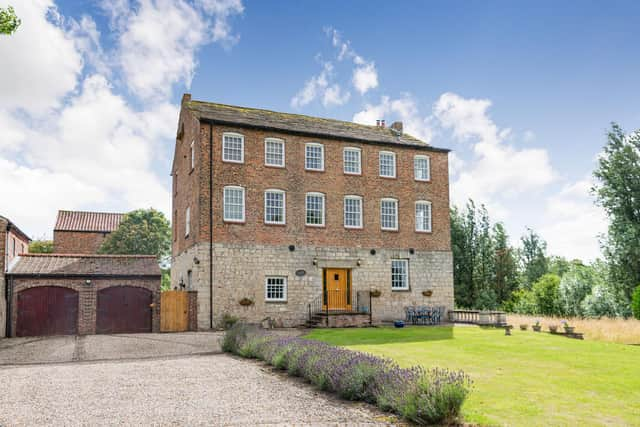
The house has a detached double garage and is set in around eight-and-a-half acres of gardens and land on the edge of the village, with a lake, orchard and meadows.
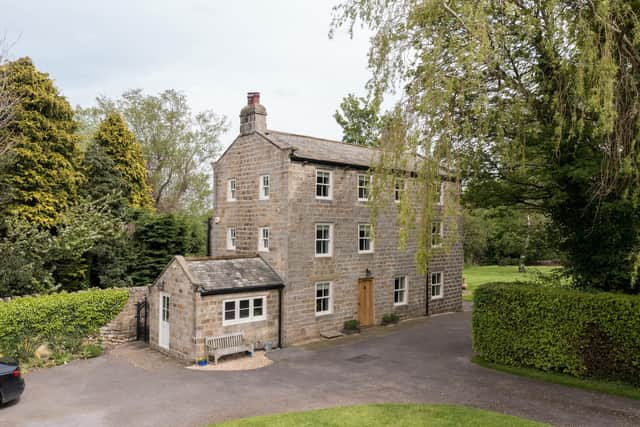
The Old Mill on the edge of Hampsthwaite is a Grade II listed former flax mill.
It has five bedrooms, three bathrooms, study, a huge open-plan kitchen/family room, two reception rooms, utility room and cellars. Outside, there’s a double garage with an attached office and extra storage space, and three fifths of an acre of gardens and woodland.
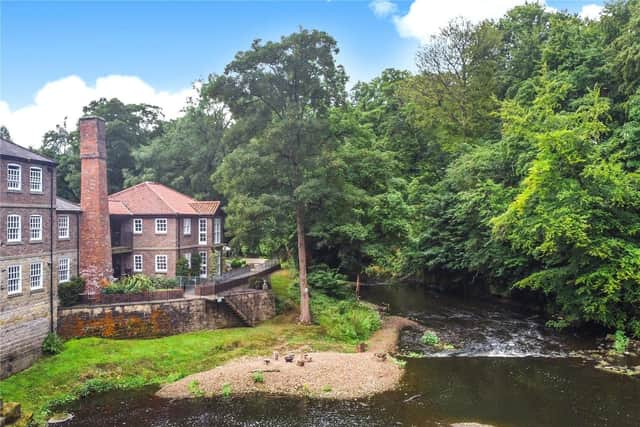
Finally, 19 and 20 Castle Mills in Knaresborough is a late addition to a linen mill complex that in 1851 employed over 400 workers.
It’s now a quiet collection of waterside flats, and planning permission has been granted to convert this linked-detached property from two flats into one three-bedroom, two-bathroom property with a further side extension.
Outside, the garden has a built-in gas fire-pit, and there are further lawned communal gardens, plus off-street parking, a double garage, and even fishing and boating rights on the River Nidd.