
Harrogate Heritage: Looking back at the discredited five-phase traffic scheme of 1969-70
For almost twenty years from 1995, the eminent local historian Malcolm Neesam contributed a series of remarkable articles to the Harrogate Advertiser. This reproduced article was originally published on June 28, 2012...
There cannot be many readers who are unaware of the fact that every few years the people of Harrogate receive news of yet another proposal to “improve” the town’s system of traffic flow.

At one time, broad roads were built to impart an air of dignity to the areas through which they passed. But since the middle of the 20th century, it had usually been the case that a road in an urban locality was made wide in order to accommodate a maximum number of vehicles travelling as fast as possible.
Yet looking back to 1933, Lord Horder, the personal physician to the Prince of Wales, spoke of the desirability of banning cars altogether from the centres of British Spas and Health centres. His reasoning was sound by the terms with which the Medical profession promoted Spa treatments, or the “Cure”, as it was then known. Along with water drinking, bodily exercise, and the relief of stress through entertainment and relaxation (eg.the kursaal), the doctors had long known that access to pure air was a key part of the recovery and maintenance of bodily health. Many continental Spas planted pine woods around their fringes, so that incoming breezes would be impregnated with fresh pine, giving the air a pleasant scent.

Where conditions were unsuitable for tree-planting, the authorities sometimes constructed huge log hurdles which could be smothered with imported pine fronds, the better to improve the quality of native air. After it acquired Harlow Moor, Harrogate Council began an intensive program of pine tree planting, and even Bogs Field (today, part of Valley Gardens) was fringed with pines.
Lord Horder made his comments on the desirability of a car free environment during his visit to Harrogate to open the council’s latest attempt to retain the town's position as the premier Spa in the British Empire. He told the council that motor vehicles with their poisonous exhausts should be kept well away from the Spa area, including Parliament Street, Crescent Gardens, Swan Road and the town centre’s three main shopping streets. Lord Horder did not suggest that new roads or routes should be created, which he said would merely shift the pollution into someone else’s back yard, but that the overall volume of traffic using the King's Highway should be reduced by legislation. History has not recorded the response of Harrogate Council to their distinguished visitor's suggestions, but by the end of the decade, motor traffic had become so heavy as to warrant a scheme drawn up in co-operation with the West
Yorkshire County Council, the basis of which was the construction of a new “relief” road for Starbeck, which would begin at Granby Corner and end near the Bogs Lane junction with Knaresborough Road. World War Two put an end to that scheme.
Various suggestions for the improval of the town's system of traffic flow were made during the1950s, but the first major post-war plan was the December 1963 road traffic scheme proposed by the West Riding County Council. This was a beauty, and in hindsight appears to have been drawn up by people who had never set foot in the town. As the Advertiser's HH Walker put it : “all done on paper”.
Although readers may find it difficult to accept that anyone could be so foolish as to suggest diverting the A61 traffic from West Park and down Montpellier Hill to the
Spa area, in order to pedestrianise Parliament Street, this is exactly what the West Riding planners proposed. The new dual carriage was cut into the Stray opposite the Alexandra Hotel, and ploughed across the grass until it reached Crown Roundabout. As Royal Parade and the Royal Pump Room were inconveniently in the way, they were all to be demolished, to enable the new dual carriage way to pass into Swan Road, itself to be doubled in width, before reaching Ripon Road, where a large new Junction would be created.
After a mammoth battle, and a petition of 36,110 signatures of opposition, the lunatic scheme was abandoned. It had been a near thing however, before public opinion won the day.
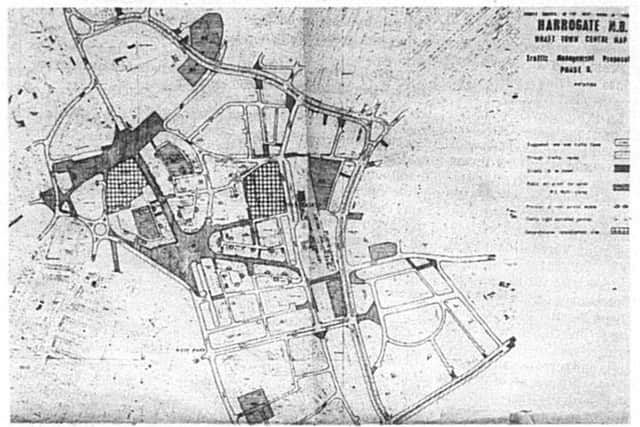
This defeat did not prevent future anti-social road schemes from being proposed, and this week’s photograph shows Harrogate Council's own scheme of 1969-70 to “improve” Harrogate's traffic flow by means of an incredible five-phase scheme, which deserves considering in detail. Yet again, Harrogate’s traditional direct through-route for traffic via the broad Leeds to Ripon Roads, via West Park and Parliament Street, was to be ditched. This time it was proposed to pedestrianize Parliament Street in order to assist the Council’s scheme to redevelop the Royal Baths site (shown as hatching) by means of diverting the A61 down Montpellier Hill, round the Royal Pump Room, and in to Swan Read. Victoria Road, Crescent Road, and Cornwall Road were to be closed to traffic. A huge “spaghetti junction” was to be built at the Ripon Road Junction with Springfield Avenue, entailing the demolition of several superb Arts and Crafts villas. The inner motorway would then be carried across the valley of Kings Road by a viaduct on stilts, entailing the closure of Franklin Road and Strawberry Dale, before reaching a huge new roundabout opposite today’s Asda. The inner motorway would have then swung south up East Parade, requiring the closure of Park View, The Parade, Station Bridge, and North Park Road, before ploughing across the site of the demolished Baptist Church and several of Victoria Avenue’s finest mansions, before running parallel to a closed South Park Road. The dual carriage way would then have entered York Place and Leeds Road, denuded of their trees for a doubling in width of the carriage way.
This article was first published on June 28, 2012.
A note from Harrogate Civic Society: It is now more than two years since Malcolm’s death. He left behind an astonishing body of work that we at the Harrogate Civic Society are determined should be preserved and enhanced for the benefit of future historians and, indeed, for the benefit of anyone who cares about Harrogate.
Not long before his passing, we discussed with Malcolm and the Advertiser republishing at least some of his articles.
Many of Malcolm’s articles dealt with the history of the town, exploring the people, places and events that helped to form the Harrogate we know today. At other times Malcolm concentrated more on contemporary issues.
While acknowledging that Harrogate could not stand still, he was convinced that change should always be tested.
In September, the first re-publication of Mr Neesam’s articles appeared and this today is the third.
We are grateful to Malcolm’s family for their approval, to Simon Kent (closely involved with securing Malcolm’s legacy) for his work researching and preparing the articles for reprint, for the advice of historian Paul Jennings and to Graham Chalmers and his team at the Advertiser for their support and encouragement.
We hope you will enjoy reading (or in some cases re-reading) these irreplaceable snapshots of history.
If you are able to add to our knowledge, or wish to know more about our work, contact us at: [email protected].