
Harrogate Heritage: A topical look back at extreme weather and its legacy of destruction
For almost 20 years, eminent local historian Malcolm Neesam contributed a series of remarkable articles to the Advertiser. Now, two years on from his death, we are proud to republish a selection of these articles:
I hope that by the time this article is published, summer sunshine will have arrived, although I am aware that unseasonable weather is nothing new to our district.

When William Grainge, Harrogate's first scholarly historian, published his most important work in 1871, he used a large collection of notes he had assembled over many years. These notes were arranged in subject order, and cover a wide-range of subjects, not all of which were exploited by Grainge in his book. After Grainge's death in 1895, the notes, known as the “Annals”, came into the possession of Harrogate Library and, thanks to the heroic endeayours of Mrs Margaret Power, a complete transcription of the Annals is available at the library for public consultation.
Grainge made notes of the several unusual weather conditions Harrogate experienced In the 19th century, which make interesting comparisons with today’s weather. For example, Grainge recorded one of the effects of a violent thunderstorm on the afternoon of Thursday, June 3,1858, when “a severe thunderstorm passed over Harrogate, Leeds and the country between them. The Bramhope Tunnel on the North Eastern Railway gave way at the Leeds end, and the water rushed through in a perfect torrent, and with tremendous noise.

“A train proceeding through the tunnel at about six o'clock in the evening was met by the current, and forced to put back; this was effected very slowly, the train being in the tunnel more than an hour. On its re-arrival at the north end, the accumulation of rubbish had been made so great, that the passengers had to leave the carriages, and walk back to Arthington. They were subsequently sent round by York, and reached Leeds about midnight”.
Two years later, on May 28, 1860, “a violent storm of wind from the north-east accompanied by heavy showers of snow, hail, and rain swept over the country, breaking branches from trees, and blighting and blackening the foliage; so much so that the country never recovered its vernal beauty.
“Large marquees, which had been erected the previous day for a festive occasion, were blown down, or bodily overturned. Scores of newly-shorn sheep perished in the pastures, they huddled together behind hedges and other fences to shelter themselves from the intense cold, and trampled each other to death.
“Chimneys were blown down in some parts of the town, and some lives were lost through the fury of the storm. Great numbers of slates and chimney pots were dislodged; so that it was dangerous walking the streets in the earlier part of the day. Early garden vegetables were cut down to the ground, and the crop partially destroyed; and the exposed sides of hedges were blackened, as if by the action of fire”.
Grainge’s following entry noted: “The summer of 1860 was one of the coldest and wettest ever known. A great part of the hay rotted in the fields, the corn never ripened properly, and although fairly harvested was a very inferior article, much of the flour was unsound. The cold uncongenial summer was followed by a winter of great length and severity. Outdoor work was suspended, and much want was felt by the poor.
“Numbers of birds perished from hunger in the fields; and the frost was so intense that it entered the houses, and water placed in a sleeping room in the evening was a mass of ice in the morning. Many lives were lost in the snow and severe cold; among which in this neighbourhood was a young man named William Bramley, apprentice to a shoemaker at Knaresborough.
"He was a musician, and along with others on Christmas Eve had been playing at Harrogate, Ripley, and other places in the neighbourhood and were returning home across Scotton Moor; when two of them were left behind, and it was believed from the effects of cold and fatigue fell down in the snow, and soon became helplessly benumbed.
“One of them was found shortly afterwards, and carried into the cottage at the toll bar where she shortly revived. William Bramley was not found until next morning when he was quite dead. He was twenty years of age on the day that he died".
A further ten years passed before Grainge noted another severe spell of weather, when on December 16, 1873, “a most destructive gale of wind passed over the Midland and Northern Counties of England. The previous night was calm and clear, with a bright star-lit sky. About four o'clock in the morning the wind increased to a storm, and from that time to ten it blew with great violence; doing incalculable damage to property; many lives were also lost.
Many pages might be filled by a very brief summary of the damage done in Leeds and Bradford alone. In Harrogate, notwithstanding its exposed situation the damage was slight in comparison with other towns, which speaks favourably for the solid construction of the buildings; though here chimney pots and slates were scattered in all directions, buildings in course of erection blown down, and many partially.
Some large elm trees were blown down near the Dragon Hotel, and three or four chimneys on the Railway Station were blown down and damaged the roof; two very large heavy stone pinnacles were blown from the western gable of the Congregational Church in Victoria Avenue, one of which passed through the roof and did much damage In the church below.
“As the first train due in Harrogate at 6 o'clock approached Weeton Station, the whole of the Railway building composed of wood were blown over and severely injured one of the guards”.
Eight years later, Grainge recorded that on March 9, 1881, “A violent storm of wind swept over Harrogate, continuing throughout the whole day, causing considerable damage to chimney pots and slates. Among other casualties, the chimney of Mr Dickinson confectioner in High Harrogate was blown over and fell through the roof of the house, doing a great amount of damage, but injuring none of the inmates.
In James Street the massive coat of arms over the post office buildings was blown down, and smashed to atoms. The worst of all was in the destruction of a large and splendid crabtree, in the first field on the footpath leading to the Bogs, (today, the Valley Gardens) when in blossom it was in reality “a thing of beauty”.
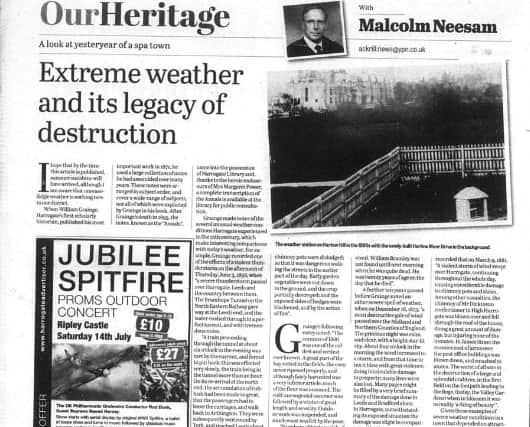
Given these examples of severe weather conditions in a town that depended on attracting a regular number of visitors, it is not surprising that the authorities established a weather station on Harlow Hill, the better to notify the public of local climatic conditions.
The results were written up and transferred to display notices that were placed in glazed display units, principally on Parliament Street, adjacent to the entrance to the Winter Gardens. Now, of course, we have instant access to weather news via the marvels of modern technology but before this had become commonplace the public relied on such local resources as the weather station.
This newspaper's HH Walker kept notes of the daily weather records (“Weather-wise”) in a series of notebooks which cover a period of about 30 years, and I wonder if one day they will be of use to a researcher?
This article was first published on July 5, 2012
A note from Harrogate Civic Society: It is now more than two years since Malcolm’s death. He left behind an astonishing body of work that we at the Harrogate Civic Society are determined should be preserved and enhanced for the benefit of future historians and, indeed, for the benefit of anyone who cares about Harrogate.
Not long before his passing, we discussed with Malcolm and the Advertiser republishing at least some of his articles. Many of Malcolm’s articles dealt with the history of the town, exploring the people, places and events that helped to form the Harrogate we know today. At other times Malcolm concentrated more on contemporary issues.
In September, the first re-publication of Mr Neesam’s articles appeared and this article continues the series.
We are grateful to Malcolm’s family for their approval, to Simon Kent (closely involved with securing Malcolm’s legacy) for his work researching and preparing the articles for reprint, for the advice of historian Paul Jennings and to Graham Chalmers and his team at the Advertiser for their support and encouragement. We hope you will enjoy reading (or in some cases re-reading) these irreplaceable snapshots of history. If you are able to add to our knowledge, or wish to know more about our work, contact us at: [email protected].