
Sex, drugs and drink - drama teacher Gary Bowman takes on the role of rebel 'Rooster' in Harrogate Dramatic Society's production of Jerusalem
Harrogate Dramatic Society is bringing Jez Butterworth’s acclaimed state-of-the-nation play Jerusalem to Harrogate Theatre next month.
Described by The Guardian as the best play of the 21st century, Jerusalem is a sprawling, funny, provocative and ultimately moving portrait of contemporary England.
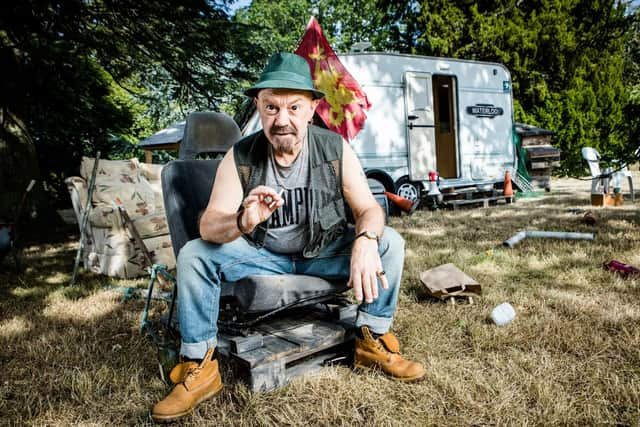

At its heart is Johnny “Rooster” Byron, an anarchic local legend living in a battered caravan in the woods outside the fictional Wiltshire village of Flintock — until the authorities decide his time there is over.
We talk to Gary Bowman who is taking on the role of rebl Rooster.
What was your first reaction when you were cast as Jonny ‘Rooster’ Byron in Jerusalem? Had you always wanted to play the role?
I was utterly delighted, it was wonderful. I was giddy for days.
Playing Johnny Byron has been a bit of a dream for me ever since I first read the play at least 12 years ago. The play rings so many bells for me, with its ‘Shakespearean’ scale, its engagement with folklore and the natural world and its ability to offer multiple points of view.
I never thought that this chance would arise. When I heard that Harrogate Dramatic Society was preparing a production – and this was 48 hours before the open audition – I knew I wouldn’t be able to forgive myself if I didn’t at least try. I still auditioned for two other roles as an insurance policy. But to actually get Byron, oh my goodness, be careful what you wish for!
For anyone who doesn’t know the play, how would you describe Rooster? What makes him such a fascinating – and complicated character to play?
Johnny Byron is an anti-hero, a subversive bundle of perversity and inspiration. He takes on the world with ludicrous swagger and bullishness but there is plenty in the play to indicate that his tough shell is just that, a shell.
The character can be complicated to play because it is hard to come to a conclusion about what it is that drives him on. But driven he is and determined to throw the hypocrisy of the ‘straight’ world back in its face, with insane levels of wit and rudeness.
He is hilariously funny. And you really, really don’t want him living next door to you.
Rooster is one of those characters who can be larger than life, funny, charismatic and deeply flawed all at once. What have you enjoyed most about getting inside his character?
I have loved getting my teeth into such a substantial role, and engaging with a character who has all this revolting vigour but also poetry and depths of vulnerability.
I will never run out of material to explore in Johnny Byron. Audiences do seem to enjoy the company of these dubious characters and I think it fulfils a basic need in us all.
We can all feel a bit suffocated by the ‘rules’, by a world that seems to require such a lot of good behaviour and such a lot of patience from us. So it can be a relief to let off steam with someone who doesn’t care.
Also – like Shakespeare’s Falstaff – he gives way – joyously, thoughtlessly – to all his basic desires. With Falstaff it’s alcohol, food and sex with Rooster it's alcohol, drugs and sex.
Jez Butterworth’s Jerusalem has become one of the great modern British plays. What do you think makes the story still resonate with audiences today?
Jerusalem hits the audience hard with comedy that is ‘earthy’ to say the least.
It would be a mistake to see it as just comic. It is very concerned with place and identity with Englishness and what that might consist of.
It was first written and performed before the Brexit referendum, so doesn’t address that particular can of worms but definitely draws on what was going on at that time, in particular with a lurch into England’s simpler, folkloric past that was an attempt to feel better about what it (we) had become.
The play is set in a Wiltshire woodland but it deals with some very universal themes – belonging, rebellion,. Friendship, growing up and feeling that the world is changing around you. What do you think audiences in Harrogate will connect with?
I think anyone in England can pick up on the way that the ordinary English people have been forced to compete with each other for a living and a living space.
The wild wood used to be a shared resource for ordinary people but then Mediaeval feudal lords denied ancient rights and reserved forests for their private leisure pursuits.
The Enclosures Acts of the 18th and 19th centuries privatised common land and pushed ordinary people to towns and cities or to the margins as the life of the land became an industry rather than a way of life.
In our local area, it is wonderful to see the Knaresborough Forest Park project trying to recuperate some of what has been lost, the ancient forest is for all of us and, in his clumsy, flawed way, Johnny Byron is trying to fight that fight in this play.
What has been the biggest challenge of playing Rooster? Is there anything about him that you’ve found particularly difficult to understand or portray?
I’m relieved to say that Rooster is quite unlike me! I don’t mean to sound like a goody-two-shoes, I just think he is much braver, more reckless and more damaged than me.
I do find it hard to understand someone who is so unreasonable, whose actions are so counterproductive and who relishes confrontation. But I envy him his brilliant imagination, his ability to tell a story and his comic abilities. He says all the things you think of saying 20 minutes after you’ve left the company of someone who annoys you.
Rooster has some brilliant relationship with the other characters, particularly Lee, Ginger and the young people around him. Which relationship have you most enjoyed exploring in rehearsals and why?
Rooster loves company, he loves banter, laughs and mischief. He chooses to hang out with people much younger than him and he is a really, really ambiguous role model or father figure.
But he does have a nurturing and empathetic side and I have been particularly affected by his attitude to the Professor, a character who has been through some hard times and some trauma.
Rooster protects him and clearly identifies with him.
What has the rehearsal process been like with the Harrogate Dramatic Society cast and director Dermot Hill? Has anything surprised you about working on such a demanding play?
I am new to Harrogate and to Harrogate Dramatic Society, so it has all been a process of discovery.
My director and fellow cast members have made life easy for me with the warm welcome I have received and I think the Society offers a very firm foundation of canny organisation and informed support.
It is my very good fortune that Dermot Hill had the vision to choose this play and that the Society had the sense of ambition to run with it.
There’s a huge amount of humour in Jerusalem, alongside some darker and more challenging subjects. How have you approached finding that balance as Rooster?
Without giving too much away, Jez Butterworth offers the audience a character who, in his own way, tries to be a virtuous knight going into battle to protect the innocent.
There is a ‘dragon’ in this play and he is confronted. But Rooster doesn’t always see himself as a hero and I have found it very rewarding to think about his struggles with himself, how he tries to protect himself and what he fears.
If you could persuade someone who has never seen Jerusalem to come along to Harrogate Theatre, what would you say to them?
I would say that this is a feast of a play, a great big gorgeous banquet of laughter, pathos and ideas.
The play absolutely does not preach, it is not ‘about’ any single thing but it invites thinking about a host of topics and opens up possibilities.
As a drama teacher I got a little bit sick of new plays that lasted less than an hour and hammered one issue to death. Jerusalem is – joyfully – not that. It is very good value for money.
A whole evening of entertainment that doesn’t patronise or short-change the audience.
Finally, Rooster is a character who certainly knows how to make an entrance. What do you think Gary Bowman and Rooster have in common – and where are you completely different?
I share with Rooster Byron a love of tree, and I share his sense of broken-heartedness when the natural world is trashed. Rooster believes in the power of storytelling, and so do I.
Rooster believes in supplying copious amounts of illegal drugs to minors. I do not.
Jerusalem runs at Harrogate Theatre from Thursday October 15 to Saturday October 17, daily at 7.30pm and a Saturday matinee at 2.30pm.
Tickets: 01423 502116 and https://www.harrogatetheatre.co.uk/